Poor motivations for gaming – No 1. Not wanting to deal with negative emotions

In my post Gaming – How to put kids in control I wrote about the research we carried out: our four sons kept a journal of their motivations to game, their emotions before and while gaming each time they started to play a computer game. Observing themselves this way they concluded:

  • Gaming is most fun if they play with friends, and
  • Gaming does not feel good if they start it to forget negative emotions or to postpone a task.

They thought that they would be in control of their gaming if they would always start playing for the expectation that it would be fun. When they are not in control, they start playing for one of these reasons:

  • suppress negative emotions,
  • postpone a task or
  • pass the time.

In this post I will discuss the first of the reasons, i.e. not willing to deal with negative emotions.

When your teen decides to play a computer game instead of processing a negative emotion, he suppresses that emotion, leaving it unprocessed. Unprocessed emotions lead to stress. So what does it mean to process an emotion? How does one know whether an emotion has been processed? We think very often that we have dealt with an emotion and still it keeps coming back. Again, I did some research and found some useful information.

Here is how we process an emotion:

  1. Turn toward your emotions with acceptance: become aware of the emotion and identify where you sense it in your body
  2. Identify and label your emotion: “This is anger” or “This is anxiety”
  3. Accept your emotions: don’t deny the emotion. Acknowledge and accept that it is there.
  4. Realize the impermanence of your emotions: even if the emotion feels overwhelming, remember that it will pass.
  5. Inquire and investigate: ask yourself: what triggered me? Why am I feeling this way?
  6. Let go of the need to control your emotions: be open to the outcome of your emotions and what unfolds.

source: https://www.gottman.com/blog/6stepstomindfullydealwithdifficultemotions/

So this is when you can submit to your emotion and act on it. However, it’s not always possible. For example, I don’t think I want my 15 year old son to beat me up or scream into my face when he’s angry at me. So how do you process emotions that urge you to do something that is not acceptable? You change those emotions:
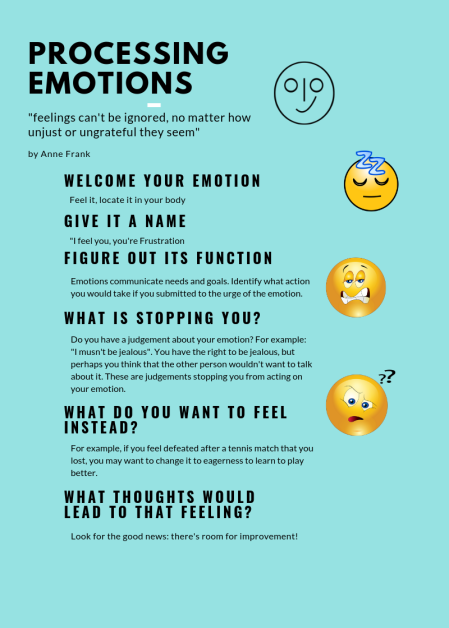
Processing emotions


The most important step for teens is to understand that processing their emotions is just as important as physical exercise. They have to find time for it: when lying in bed alone with their thoughts and emotions, or sitting on the backseat of the car, or walking to school.


 

Gaming – How to put kids in control

I’m worried, just like many other parents, that my kids miss out on important things when they choose to play computer games instead of pursuing other activities. When I see them play tennis or make music together, I feel happy and proud, but when I see them with their phones or controllers, I feel compelled to instantly assign them a task. But I know I can’t do that, and I don’t want to control them anyway. I want them to be in control instead.

That being said, we all – parents of teens – know that we can’t just let go of the control. It will take a long learning process before you can be certain that they are ready.

To define what it means to be in control when it comes to gaming we carried out an experiment for a period of one week: I asked them to write down every time they play a game why they started to play and how it feels to play. And, in exchange, I promised to stop nagging them for that week.

Here is what I learned from this experiment:

Being creative with Minecraft

They enjoy playing at most when they play with their friends online. Building in Minecraft, or games that make them laugh are fun too.

On the other hand, they do not enjoy playing when they start it in order to oppress anger or another negative feeling. Then they get annoyed by the game very quickly.

Among the various reasons they mentioned for gaming was avoiding boredom. For them this apparently is just as good a reason as any.

After we looked at all their notes together, I asked them to define what “being in control” means for them. They formed an amazingly clear definition:

You’re in control if you start gaming for a good reason: to have fun. If you start to play for poor reasons, you’re not in control.  For instance if you start gaming to postpone a task or to forget about a negative feeling. Furthermore, to be in control you need to be able to stop any time and before you have played too long, which is if you don’t enjoy it anymore.

They do not think that they are in control of their gaming at the moment: they admit that they more often start gaming for poor reasons than for good reasons.

So, here is what we need to do: eliminate the instances when they start for a bad reason. In my recent post Extensive gaming teens I reviewed some quick fix tools, such as making gaming a privilege rather than a right, discussing policies at family meetings and offering attractive activities as alternatives. All of these can help, but leaving the poor reasons to play untreated, such as postponing tasks and suppressing negative feelings may jeopardize the success of any attempt to cut down on gaming. So here is my plan: teach them how to show up for their tasks, how to deal with negative emotions, and how to make use of their free moments. Sounds easy, doesn’t it?

For a quick fix, we set up a rule that they can only play at times agreed in advance with their friends. This involves making plans together with their friends which is a challenge by itself. This proposal came from the kids themselves.

And as for the learning process, stay tuned and follow our path!


Teen school break negativity

Noe (15) shows up to late for breakfast. He is morose, mean with his brothers and won’t talk to us. He keeps saying that he doesn’t feel like doing anything at all. I read somewhere that you cannot change their moods. But why keeps he saying it to me? In my reading this is a call for help. So I suggest:

Why don’t you go for a run or do some yoga?

He answers something that is more like a bear’s bawl and means “get off my back” to me. I go on explaining why I think that would help. He walks out of the kitchen where I was tidying up.

Clearly, I didn’t handle this in the right way. But he comes back again after a while to complain about his bad mood. This time I know what I have to ask:Morose teen boy

Noe, would you like to get out of this negativity?

He does want to get out of it he says.

So what can you do to get out of it? – I’m genuinely curious if he can think of a solution (that I haven’t thought of).

He’s thinking. Then he says:

I guess the only solution is to go for a run.

And so he did. He was doing much better when he came back. And I’m amazed how powerful it is if you ask real questions, if you’re open for any answer.