Poor motivations for gaming – No 1. Not wanting to deal with negative emotions

In my post Gaming – How to put kids in control I wrote about the research we carried out: our four sons kept a journal of their motivations to game, their emotions before and while gaming each time they started to play a computer game. Observing themselves this way they concluded:

  • Gaming is most fun if they play with friends, and
  • Gaming does not feel good if they start it to forget negative emotions or to postpone a task.

They thought that they would be in control of their gaming if they would always start playing for the expectation that it would be fun. When they are not in control, they start playing for one of these reasons:

  • suppress negative emotions,
  • postpone a task or
  • pass the time.

In this post I will discuss the first of the reasons, i.e. not willing to deal with negative emotions.

When your teen decides to play a computer game instead of processing a negative emotion, he suppresses that emotion, leaving it unprocessed. Unprocessed emotions lead to stress. So what does it mean to process an emotion? How does one know whether an emotion has been processed? We think very often that we have dealt with an emotion and still it keeps coming back. Again, I did some research and found some useful information.

Here is how we process an emotion:

  1. Turn toward your emotions with acceptance: become aware of the emotion and identify where you sense it in your body
  2. Identify and label your emotion: “This is anger” or “This is anxiety”
  3. Accept your emotions: don’t deny the emotion. Acknowledge and accept that it is there.
  4. Realize the impermanence of your emotions: even if the emotion feels overwhelming, remember that it will pass.
  5. Inquire and investigate: ask yourself: what triggered me? Why am I feeling this way?
  6. Let go of the need to control your emotions: be open to the outcome of your emotions and what unfolds.

source: https://www.gottman.com/blog/6stepstomindfullydealwithdifficultemotions/

So this is when you can submit to your emotion and act on it. However, it’s not always possible. For example, I don’t think I want my 15 year old son to beat me up or scream into my face when he’s angry at me. So how do you process emotions that urge you to do something that is not acceptable? You change those emotions:
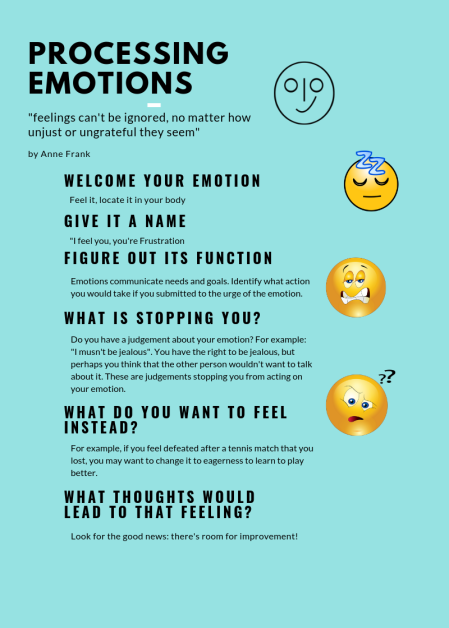
Processing emotions


The most important step for teens is to understand that processing their emotions is just as important as physical exercise. They have to find time for it: when lying in bed alone with their thoughts and emotions, or sitting on the backseat of the car, or walking to school.


Extensive gaming teens


In my post Screens – Is your teen in control? I tried to find an answer to the question: what is extensive screen time? In the case of my sons screen time is narrowed down to gaming, or more specifically “social gaming”: they play with their friends online. To find the answers, I carried out an experiment involving my four sons (ages 6 to 15). I have received a pretty good answer from them as to how to approach this question. I will share it with you in my next post. But first, let’s see what you can find on the Internet about this topic.

Since mid-2018, a new concept, referred to as gaming disorder is included in the International Classification of Diseases. It is defined as a pattern of gaming behavior (“digital-gaming” or “video-gaming”) characterized by

  • impaired control over gaming,
  • increasing priority given to gaming over other activities to the extent that gaming takes precedence over other interests and daily activities, and
  • continuation or escalation of gaming despite the occurrence of negative consequences.

For gaming disorder to be diagnosed, the behaviour pattern must be of sufficient severity to result in significant impairment in personal, family, social, educational, occupational or other important areas of functioning and would normally have been evident for at least 12 months.

So you can have your child screened if you have doubts. That being said, I searched the internet for gaming disorder screening services in Europe, and could not find an institute offering this service.

Extensive gamingMost of us parents tend to think we can relax when reading the definition of gaming disorder because our teen has not gone that far and probably never will. On the other hand, we would want our teen to spend less time on gaming, and more time on “useful things” because we want them to do better in everything except for gaming. In addition, we want to interfere before it gets worse.
Parenting sites suggest various measures to reduce screen time, however, most of these sites focus on children. For teens, you need other technics. The few sites that do focus on teens, are more relevant for social media addicts. However, I found some of the recommendations for teens’ screen time by verywellfamily.com useful. I will certainly take over their idea to make screen time a privilege as opposed to a right. Especially with siblings, fighting for screen time, it can indeed become a sort of a right. Each of them argue for their right to play not less than his brother or sister. It is even more complicated with more than two siblings: the standard is always set by the one who has played the most on that day.

Organising family activities as an alternative for gaming is a good thing, and it certainly helps. But it has its limits. The kids still have plenty of time to play and parents have limited time for activities. Also, having several kids of different ages makes it difficult to find activities that are attractive for everyone.

Family meetings can also help to reduce screen time, but the kids need to be willing to cooperate. If you stick to democratic decision making, and you have two kids or more, they can even vote against you. If they are not ready to cut down on screen time, you will find yourself very quickly in the blaming role during the meetings and they will fight back or ignore you. My post Family meetings based on equality offers a solution to get rid of the blaming role. But without motivation, family meetings alone won’t help.

What does help is if you have one on one conversations with them to find their inner motivation to reduce gaming time. After that you can start teaching them how to act on the motivation. And then you can put them in control.  Look for my next post if you would like your teen to spend less time on gaming.

Screens – Is your teen in control?

Do you often feel that their screen-time is running out of hand? Have you ever asked yourself why it is bothering you?

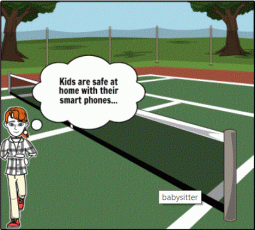
Mom playing tennis while kids on screens

“When we were kids, we used to play outside”, I`d like to say to them. But I won’t. I don’t even know why I have a problem with them being on screens. I only know that I often feel stressed when I find them gaming. I’m not a control freak, except when it comes to screen time. Time to find a solution.

I have to come to understand my own concerns first. Here are the steps to clean my mind:

I don’t like my kids spending too much time on gaming. This is my starting point.

This combines a thought and a feeling. I think that my kids spend too much time on screens. But the fact is, that I don’t even know, how much time they spend on screens, and I don’t have an idea what is too much time anyway. So I should just say that they spend some time on screens, and that’s a fact. The thought “too much” is subjective. It is not a fact, just a thought.

This thought causes me feel out of control, even angry from time to time when I get tired of controlling my emotions. Sometimes I act on my anger and demand that they shut down the screens immediately.

Would I want to bother controlling their screen time if I knew that they are in control for themselves? No. I’d be happy to let go of this control.

You may want to play this on your own thoughts too. It will at least take care of your side of the issue and help you figure out what you would like to achieve.

So step one for me is to check if they are in control of their own habits concerning screens. How do I do that?

Firstly, I asked them to write down all their thoughts for a period of one week, before they start gaming and after they’ve stopped. The deal was that I would stop nagging them if they co-operate. It was easy to convince them.

I’m sure each young person is triggered by diverse motivations, so I expect four different results for my four kids. Your children would have different motives again.

In my next post I will hopefully be able to tell you what I want to do next about my kids’ screens-habits after I have come to understand their motives.

Are you disturbed by the screen-habits of your kids? Have you analyzed your thoughts? What was your conclusion? How would you find out if your kids are in control of their screen habits? I’d love to read your comments.

Family meetings based on equality

We have been doing family meetings for years now. At least once a week. Recently they have tended to fall apart: the two younger boys (6 and 10) get bored very quickly and the two teens (13 and 15) becoming apathetic. Other times they storm out of the room and slam the door.

I was wondering why this was happening. Everyone in the family considers the meetings important but when it comes to discussing certain issues such as study time and screen time, that is when the meetings disintegrate. So, I decided to stay out of the discussions at one of the meetings and observe instead. Here is what I noticed: us parents can’t hide our disappointment and the kids are constantly apologizing for not coming up to our expectations. When they realize what’s happening, they rebel and refuse to make any plans that would bind them.

So I suggested a sort of thought experience, inspired by John Rawls’ veil of ignorance concept. Let’s pretend that no one has a record of achievements (or failures), we don’t know about each other’s priorities, so no initial expectations. In Rawls’ experiment, you should act out of a position where you don’t know what role in the society you would take.

original_position
Philosophyink [CC BY-SA 4.0 (https://creativecommons.org/licenses/by-sa/4.0)%5D, from Wikimedia Commons
So, we as parents should try to envisage what it is like to be a teenage boy. We should try to remember for example what it feels like to concentrate on your study book when your body is overwhelmed by fluctuating hormones. They should on the other hand try to imagine how many different responsibilities we have as parents, citizens, income producers etc.

We tried this on Saturday morning. It was a complete failure: we all fell back in the old roles, we were on different pages, all of us, and the meeting ended up in arguments. We tried again on Sunday. It went somewhat better: we noticed when we were blaming each other and immediately tried to correct it. But we avoided discussing the biggest issues. At least we managed to do the planning for the day…

We’ll keep trying. It takes practice. In the meantime, I will work one on one with them on the big issue: SCREEN TIME! I have great expectations from coaching methods in this regard. I’m working with the kids on an experiment aimed to find out what is motivating them when they sit down at their gaming computer or the phone. If you think that your kids are spending too much time on internet, please follow and comment my posts tagged “teenage screen time”! I will appreciate it.

Chronic late teen – when to coach your child

Noe (15) comes in my room just when I’m ready to go to sleep. He wants to talk, and I know about what. He had a conflict with his father. I thought they had reconciled. So what is his pain?

“We said our sorrys, but they came with buts” – he says.
“And at the end, Martijn summerised what our deal was. He concluded that I would do my best not to be late.”

I know how disturbing it is for Martijn that Noe never leaves the house in time to get to school or to his activities on time. I ask:

“So what’s wrong with that? ” I would be thrilled if Noe could change his habit of chronic lateness. But I have serious doubts if it can be achieved with one short discussion.

couch
Difficult to get up

“I don’t know, there’s nothing wrong with it, but…”
“Do you want to get in the habit and leave on time?”
“Yes.”
“What would be different if you left on time?”
“I would not be stressed.”
“Why are you stressed?”
“Because I leave late but still try to get there on time in order not to disrespect the teachers and the coaches.”
“On a scale of 10, how hard do you want to leave on time on a regular basis?”
“seven”
“What score would you give to the likelihood that it is actually going to happen?”
“four”
“So what is going to hold you back?”
“It’s too difficult to get up from the couch.”

I stopped here because I wanted to think about this. What is it that he wants from me? My help to change his chronic lateness? Or my help to resolve his conflict with Martijn? Should I pursue this chance and guide him to change his bad habit anyway? I will have to ask him.

The next morning, business as usual: he was late from school, and in the afternoon late again, for his tennis training. I was furious and he was saying it was none of my business.

I see it now, he merely wanted me to help him resolve his conflict with his father the other day. He had no intention to try to change at all.

If I tried to talk to him about changing his priorities, I would not get through. Not yet. I am ready to stay out of this and keep my fingers clean. He will get to the point of really wanting to change once the consequences become serious enough. But I will keep asking him every now and then if he wants my help.

Coaching my family

Hi, I’m Sarolta, mother of four boys aged between 6 and 15. In this blog I will document my learning path of becoming the very best coach for my sons.

With my oldest son becoming a young adult, I have no choice but to learn how to assist him as a co-pilot on his flight to maturity. I am looking forward to every moment of it!

So my conscious learning really starts now: I have enrolled to a coaching school and am thrilled to dedicate all my free moments to studying and practicing the art of coaching.

I will share with you all the coaching and parenting tools I try on my way. I’ll tell you how I applied them and to what extent they helped us. I’m dedicated to truthfully describe all my thoughts and feelings: despair, doubts, cluelessness, joy and satisfaction we experience.

With four sons, you can guess how many times a day I should use one or another coaching skills. I will share with you the three most challenging cases each week.

Please do not hesitate to give me any feedback or advice for my posts – I will apreciate it very much.